Configure the controls. Don't code them. Don't re-validate them every time the FDA expands Part 11.
The Validation Lead at a regulated life-sciences operator carries the cost of every FDA Part 11 expansion. Each new sub-clause — AI-assisted decision support, remote monitoring, cloud-deployment witnessing, e-signature scope expansion — historically requires a vendor project to validate. Months of work; six-figure cost; recurring with each FDA Part 11 update. The validated-state drift between updates is itself a finding.
Talk to a Validation solutions engineer · Read the FDA 21 CFR Part 11 overlay
"Every new Part 11 expansion costs me a vendor project to validate."
"Every new Part 11 expansion costs me a vendor project to validate. The cost is unsustainable." — Validation Lead, life-sciences mid-market
3 failure modes recur:
- Each legacy GMP system has its own Part 11 controls implemented as custom code. Vendor change → re-validation.
- Sub-clause expansions (AI-decision-support; cloud-witnessing) trigger custom-control work in every system. Multi-vendor multiplier.
- The validated baseline drifts as systems patch, upgrade, or integrate. Validated-state assertions become inferences.
What TeamSync gives the Validation Lead.
1. Part 11 controls as configurable, not coded.
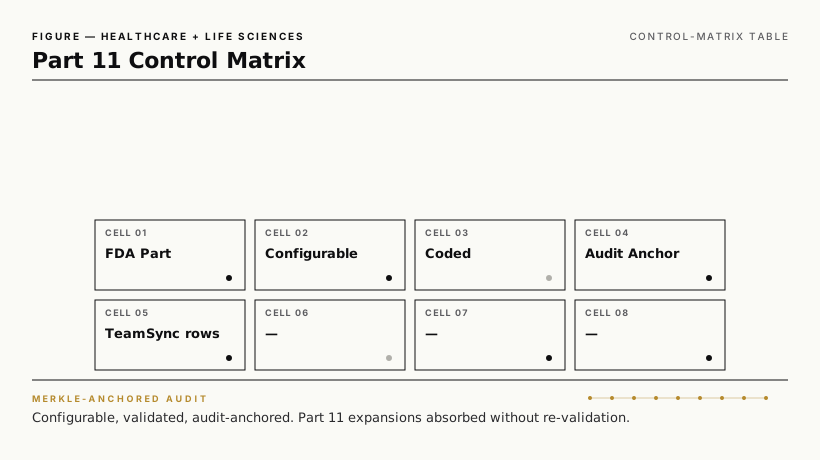
The configurable controls in TeamSync — record retention, audit trail, e-signature flows, access controls, copy/print restrictions — map to Part 11 Sections 11.10, 11.30, 11.50, 11.70, 11.100. Configuration changes do not require code re-validation; the validation pack covers the configuration surface.
2. Validated baseline deployed; audit-anchored.
The TeamSync validation pack provides the IQ/OQ/PQ documentation, the validation-test scripts, the user-acceptance evidence — all baseline-deployed. The customer's incremental validation effort is per their specific configuration, not a full ground-up validation.
3. Validated-state drift detected automatically.
The audit ledger anchors every change to the configured controls. Any drift from the validated baseline surfaces as an audit-ledger event flagged for the validation team.
4. Part 11 expansions absorbed via configuration.
When the FDA expands Part 11 (recent: AI-assisted decision support, remote monitoring, cloud-deployment witnessing), TeamSync's configurable surface absorbs the change. The Validation Lead applies the configuration; the validation pack is delta-validated; production goes live without a multi-month vendor project.
Compliance frameworks served.
| Framework | Coverage |
|---|---|
| FDA 21 CFR Part 11 Sections 11.10, 11.30, 11.50, 11.70, 11.100 | Configurable controls + validated baseline |
| EU GMP Annex 11 | Equivalent EU computerised-system requirements |
| GAMP 5 | Risk-based validation approach |
| ICH Q9 (Quality Risk Management) | Risk-based control configuration |
| HIPAA, SOC 2, ISO 27001 | Cross-vertical |
CTAs.
| If you are… | Do this |
|---|---|
| Validation Lead | Talk to a solutions engineer |
| CQO sponsoring the validation programme | Read the CQO page |
| Regulatory Affairs Lead preparing for Part 11 expansion | Read the FDA Part 11 overlay |
Related capabilities
- Intelligent Repository, Electronic & Digital Signatures, Business Rules Engine, Tamper-evident audit ledger