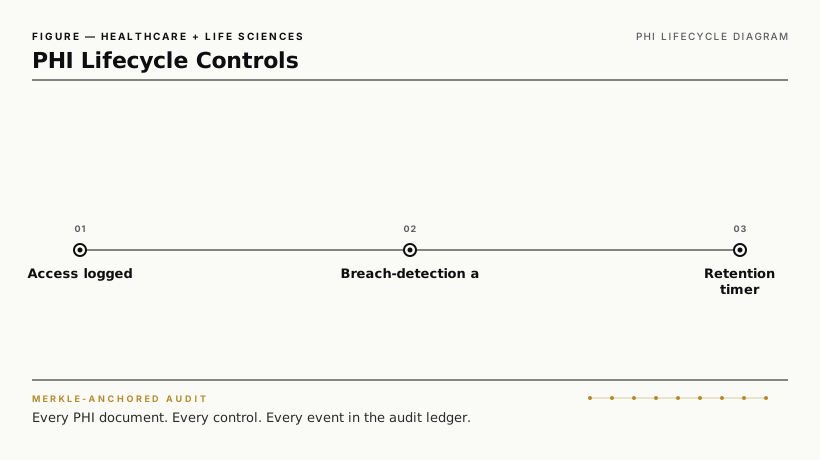
Every PHI document. Encryption, access log, breach detection, proof of disposition.
The Healthcare CISO carries personal accountability for HIPAA + HITECH conformance on every PHI document the organisation touches. Encryption at rest, encryption in transit, access controls per minimum-necessary, breach-detection capability, audit logs, proof of disposition. The HHS Office for Civil Rights enforcement record makes the consequences clear: 2024 monetary penalties exceeded USD 11M against single covered entities; corrective action plans run multi-year.
Talk to a Healthcare CISO solutions engineer · Read the HIPAA compliance overlay · Read the HLS microsite
"Every PHI document has a HIPAA exposure."
"Every PHI document has a HIPAA exposure. I need encryption, access logging, breach-detection capability, and proof of disposition." — Chief Information Security Officer, hospital network
3 failure modes recur:
- Encryption story is uneven across the PHI estate. EHR-embedded PHI is encrypted; the radiology PACS images are encrypted; but the IRB packets, the patient correspondence, the deceased-patient records, the third-party-billing documents may not be — or may be encrypted under a key the CISO does not control.
- Access logging fragments across systems. When OCR asks "show me every access to this patient's records across the period," the answer requires N queries reconciled by hand.
- Proof of disposition is a policy assertion, not cryptographic evidence. "We deleted those records" cannot be defended against the right-to-erasure equivalent (HIPAA 164.524) or the OCR investigation.
What TeamSync gives the Healthcare CISO.
1. Per-tenant envelope encryption with crypto-shred.
Every PHI document encrypted under a per-tenant key the customer controls. Crypto-shred at offboarding (or per-record at GDPR Art. 17 / state-PHI-erasure-equivalent request) destroys the key — the encrypted bytes become mathematically unreadable. HHS-OCR-grade proof of disposition.
2. Access logging in the Merkle audit ledger.
Every PHI access — read, edit, share, AI query — anchored in the Merkle audit ledger. HIPAA 164.312(b) audit-controls satisfied by default. OCR's "who accessed this record" question is one query.
3. Breach-detection capability via permissions-aware AI + anomaly thresholds.
DocuTalk refuses to retrieve documents the user cannot access; Permission Manager blocks retrieval at the ACL layer; access-pattern anomalies (volume, time, geography) trigger configurable alerts.
4. RBAC File-Level Backup preserves the recovery posture.
RBAC Backup & Restore keeps cross-region snapshots with ACL preserved through restore. HIPAA 164.308(a)(7) contingency-plan evidence pre-formatted.
5. eDiscovery for OCR investigations and right-of-access response.
eDiscovery preservation in place + collection in minutes makes HIPAA 164.524 right-of-access responses (30-day SLA) routine; OCR investigation responses similarly fast.
What changes for the Healthcare CISO.
| Concern | What changes |
|---|---|
| HIPAA breach-notification readiness | Real-time anomaly detection + audit chain |
| OCR investigation response cycle | From multi-week panic to days |
| Proof of disposition | Cryptographic vs policy assertion |
| HIPAA 164.524 right-of-access | 30-day SLA met routinely |
| HITECH breach-cost exposure | Reduced via crypto-shred-based limited-scope delete |
| Internal-audit preparation | Pre-anchored evidence pack |
Compliance frameworks served.
| Framework | Coverage |
|---|---|
| HIPAA Security Rule 164.312(a) (access control) | Per-tenant key + ACL evaluation |
| HIPAA 164.312(b) (audit controls) | Merkle audit ledger |
| HIPAA 164.312(c) (integrity) | Cryptographic chain |
| HIPAA 164.312(e) (transmission security) | TLS + per-tenant key |
| HIPAA 164.310(d)(2)(i) (disposal) | Crypto-shred |
| HIPAA 164.308(a)(7) (contingency plan) | RBAC Backup + Restore |
| HIPAA 164.524 (right of access) | eDiscovery + 30-day SLA |
| HITECH breach-notification (NIST 800-66) | Anchored access logs |
| SOC 2, ISO 27001, GDPR Art. 17 | Cross-vertical |
How TeamSync compares for the Healthcare CISO.
| Capability | TeamSync | Epic / Oracle Health audit | Microsoft 365 GCC + Purview | Box for Healthcare | OpenText for Healthcare |
|---|---|---|---|---|---|
| Per-tenant key with crypto-shred | ✅ | EHR-embedded BYOK | Customer Lockbox | KeySafe | BYOK |
| Cryptographic audit ledger across PHI | ✅ Merkle | EHR audit log | Purview audit | Standard log | Standard log |
| Breach-detection with anomaly + ACL | ✅ | EHR-embedded | Microsoft Defender | Box Shield | OpenText |
| HIPAA 164.524 right-of-access in 30 days | ✅ Routine | EHR-driven | Manual | Manual | Manual |
| Cross-PHI / non-PHI estate (HR, finance, legal) | ✅ | EHR-only | M365-bound | Box-bound | Multi-product |
Important: TeamSync coexists with Epic / Oracle Health (Cerner) for clinical EHR content. The TeamSync Healthcare CISO scope is the non-EHR PHI estate (IRB packets, patient correspondence, deceased-patient records, third-party-billing documents) plus the broader non-clinical estate.
CTAs.
| If you are… | Do this |
|---|---|
| Healthcare CISO at a hospital network | Talk to a solutions engineer |
| Privacy Officer under HIPAA | Read the HIPAA compliance overlay |
| CMIO designing clinical-AI deployment | Read the CMIO page |
| CIO sponsoring the HIPAA programme | Read the HLS microsite |
Frequently asked questions.
Does TeamSync replace Epic or Oracle Health?
No. EHR-embedded PHI stays in Epic / Oracle Health. TeamSync handles the non-EHR PHI estate plus the non-clinical estate.
How does crypto-shred interact with HIPAA retention?
Records under HIPAA retention (typically 6 years post-disclosure) cannot be crypto-shredded until retention elapses. TeamSync's crypto-shred workflow respects retention; partial / per-data-subject crypto-shred is available for granular HIPAA 164.524 fulfilment.
What about state-level PHI laws (CCPA-PHI, NY SHIELD, Texas HB 300)?
State-level overlays configurable per state. Audit-ledger evidence regulator-agnostic.
Related capabilities
- Intelligent Repository, RBAC File-Level Backup & Restore, eDiscovery, DocuTalk, Tamper-evident audit ledger, Crypto-shred